I am based in India, and most of the accounts I work on arrive through people I know rather than through a pitch. A wedding photography business owner I had been talking to for months eventually asked me to look at his Google Ads account, which had been running for a while and was quietly losing him money.
The first thing I did was not open his campaigns. I worked out what a booking was worth to him, how many clicks it took to produce one enquiry, and how many enquiries turned into a booking. Clicks were costing him ₹80, under a dollar at the time.
Under a dollar a click sounds cheap if you are used to US paid search, where a click in a competitive service category can cost twenty times that. It was still far too expensive for him. What matters is never the absolute price of a click. It is the price of a click measured against what a customer is worth to you, and on that measure his account had no path to profit.
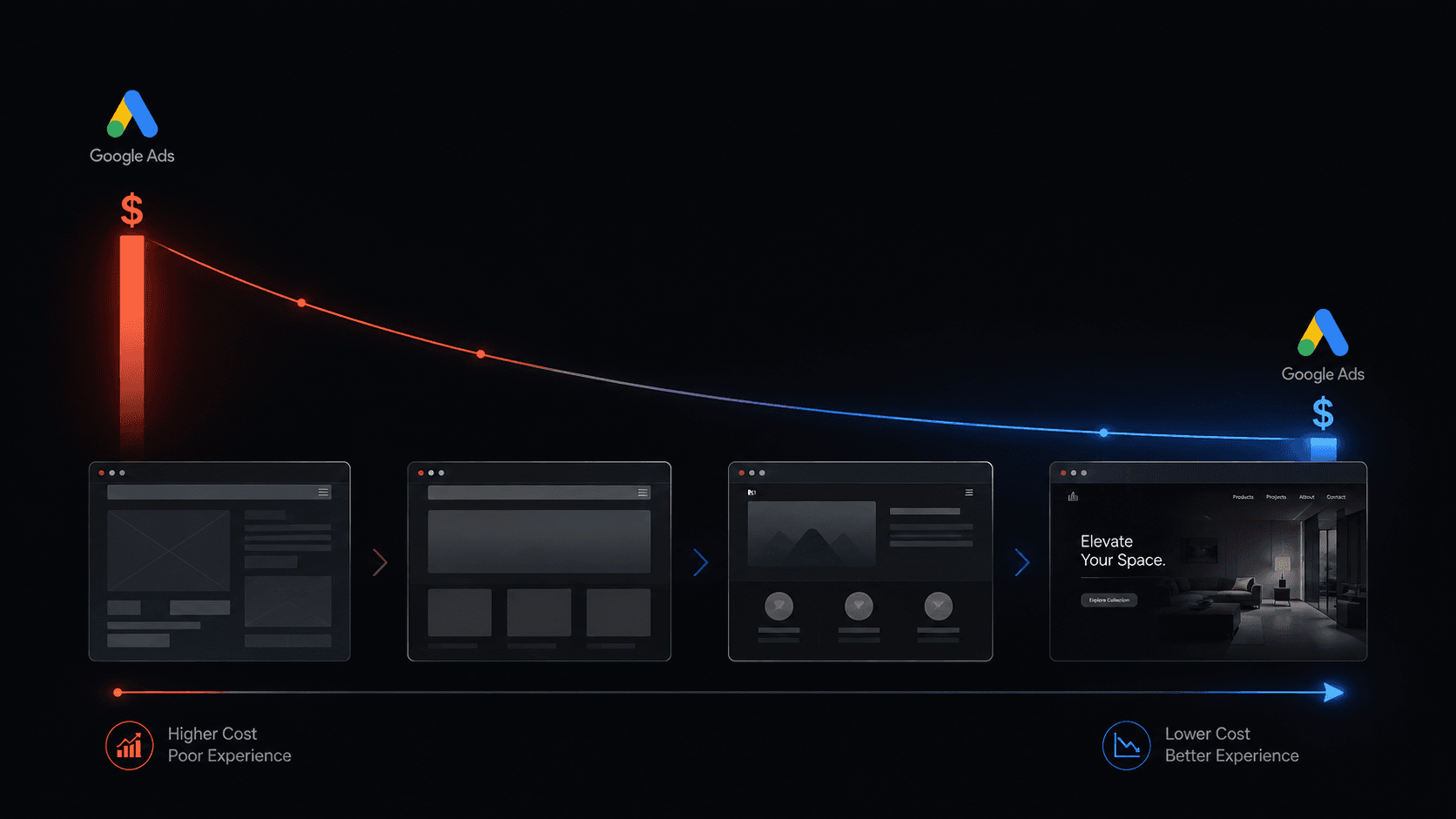
The problem was not in the campaigns. His website was pulling down the quality of his ads, and ad quality is one of the things Google prices clicks on.
So I told him the thing nobody enjoys saying. I could not run ads profitably against a page of that quality, and I would rather give his money back than spend it proving the point. He could rebuild the site first, or we could stop.
He rebuilt. When we relaunched the same campaigns on the same keywords in the same account, clicks came in at ₹21.
That is a 74% drop in what he paid per click, and not one setting inside Google Ads changed to produce it.
Most advice on using Google Ads for lead generation treats the landing page as something to improve later, once the campaign is running. That order is backwards. Here is why, and what to get right in the account once the page is sorted.
Work out whether the maths can close before you spend
Before you write a single ad, you can find out whether paid search can be profitable for you. You need four numbers, and three of them you already have.
- Your cost per click. Google's Keyword Planner will estimate this for your keywords, and the estimate is usually close enough to plan with.
- The share of clicks that become enquiries. This is your landing page conversion rate. If you have never measured it, assume something low and pessimistic to start.
- The share of enquiries you close. Your sales team or your own calendar knows this.
- What a closed sale is worth to you.
Divide your way down the chain and you get a cost per sale you can compare against the sale's value.
Take a service business paying $8 a click, where 3% of clicks become an enquiry and 1 in 5 enquiries becomes a customer worth $2,000. Now hold every one of those numbers steady except the landing page, and halve only its conversion rate.
| Page converts 3% | Page converts 1.5% |
|---|
| Cost per click | $8 | $8 |
| Clicks per enquiry | 33 | 67 |
| Cost per enquiry | $267 | $533 |
| Enquiries per customer | 5 | 5 |
| Cost per customer | $1,333 | $2,667 |
| Value of a customer | $2,000 | $2,000 |
| Profit per customer | +$667 | -$667 |
Same keywords, same bids, same sales team. One column is a business and the other is a slow leak.
Halving your landing page conversion rate does not halve your results. It doubles your cost per customer, and it can turn a profitable channel into a loss-making one. That is the first reason the page matters. The second reason is less well known and it is worth more.
What actually decides your cost per click
You do not pay your bid. Your bid is one input among several into Ad Rank, which is what Google recalculates for every single search to decide whether your ad shows, where it shows, and what you pay.
Google's own documentation on Ad Rank names six factors that determine it:
- Your bid
- The quality of your ads and landing page
- The Ad Rank thresholds
- The competitiveness of an auction
- The context of the person's search
- The expected impact from your ad assets and other ad formats
Note the second one. Google is direct about what it means for your costs: "Higher quality ads can often lead to lower CPCs. That means you pay less per click when your ads are higher quality."
So two businesses bidding identically on the same keyword can pay different amounts per click, and part of that gap is the page each one sends traffic to.
Where the landing page enters the calculation
Quality Score is the diagnostic Google gives you for this, scored 1 to 10, and it breaks into three components: expected clickthrough rate, ad relevance, and landing page experience. Google defines that last one as "How relevant and useful your landing page is to people who click your ad."
One correction worth making, because a lot of published advice gets it wrong. Quality Score itself is not what the auction uses. Google states plainly that Quality Score "is not an input in the ad auction" and describes it as "a diagnostic tool to identify how ads that show for certain keywords affect the user experience." The auction assesses your ad and landing page quality directly. Quality Score is the report card, not the mechanism.
Your landing page is the only asset in a lead generation campaign that affects both what you pay for a click and what happens after the click. Every other lever moves one or the other. This one moves both, which is why fixing it first changes the economics faster than anything you can do inside the account.
How rebuilding one landing page cut cost per click by 74%
Back to the photography account, because the diagnosis is the part worth copying.
His site loaded slowly, said very little about the specific service the ads were selling, and buried the enquiry form below a scroll. A visitor arriving from an ad for wedding photography landed on a page that talked in general terms about the studio. Nothing on it answered the question the person had just typed into Google.
That is what Google means by landing page experience, and it was showing up in his costs before it ever showed up in his conversion rate. I could see the account was being charged a premium for every click, and I could see that the clicks it did buy were arriving somewhere that would not convert them. The same weakness was billing him twice.
The choice was to keep optimising the campaigns and hope, or to stop and fix the cause. Optimising would have produced small wins on a base that could not support them. I have watched agencies bill for months of that work and call it progress.
We rebuilt the site around the service the ads were actually selling, with the offer stated at the top and one obvious way to get in touch. After the relaunch the ordinary optimisation work compounded on a base that could finally carry it, and the engagement returned roughly 15x from the first month.
Two honest caveats, because one account is not a benchmark. This is a single client in one vertical and one market, priced in rupees against Indian click costs that will look nothing like yours, and a 74% drop is not what a rebuild produces on average. What generalises is the cause and the direction, not the size: ad and landing page quality is a priced input to the auction, so improving the page lowers what you pay, on top of the conversion rate gain.
A rebuild also does not fix everything. It will not create demand for a service nobody searches for, and it will not save an account bidding on the wrong keywords. What it removes is a tax you were paying without knowing it. If the page is the constraint rather than the account, that is work for a conversion rate optimization agency before it is work for a media buyer.
Setting up a lead generation campaign that does not leak
With the page sorted, the account still has to be built properly. The failures here are boring and consistent.
Search campaigns first, automation later
Start on Search, targeting people typing the problem you solve. Performance Max and Display can work, but they are poor places to learn what converts, because they spend across surfaces you cannot see into. Get a Search campaign producing leads you can trace, then expand.
Match types and negative keywords
Use exact and phrase match on the services that matter most to you. Broad match hands Google discretion over which searches you pay for, and early in an account, before it has conversion data to learn from, that discretion costs you money.
Then read your search terms report every week and add negative keywords for the searches you never want to pay for again. In most accounts this means blocking people looking for jobs, free options, DIY instructions, and courses in your subject. This is the single highest-return habit in account management, and almost nobody does it consistently.
Exclusions worth making on day one
Turn off Search Partners and the Display Network in your Search campaigns. Both are enabled by default, both spend from the same budget, and neither carries the intent you selected Search for. You can test them deliberately later, with their own campaign and their own budget, where you can judge them on their own numbers.
Counting leads, not clicks
Set up conversion tracking before you turn a campaign on, not after. An account without it is not being optimised, it is being guessed at, and Google's bidding has nothing to learn from.
For most service businesses the calls matter more than the forms. Track calls from ads and from your website, with a minimum duration so a ten second wrong number does not count as a lead. Then close the loop: feed what happened to those leads back into Google Ads, so it learns which clicks became customers rather than which clicks became form fills. A campaign optimised toward form fills will find you people who fill in forms, and some of them will never buy anything.
What Google Ads costs for lead generation
The most common question is some version of "is $10 a day enough". The answer depends entirely on your cost per click, and you can work it out in about a minute.
At $8 a click, $10 a day buys you a click and a bit. If 3% of clicks become enquiries, you are waiting roughly a month for a single enquiry, and several months before you have enough data to know which keyword produced anything. You have not bought a campaign. You have bought a very slow experiment.
A workable budget is one that buys enough clicks to learn something inside a few weeks. Take your expected cost per click, multiply by 100, and treat that as roughly what you need to spend before judging a campaign. At $8 a click that is $800, and if that number is uncomfortable, the honest read is that paid search in your category is expensive and you should know that before starting rather than after.
Cost per lead follows the same arithmetic from the first section. Your cost per click divided by your landing page conversion rate is your cost per enquiry, and there is no industry average that will tell you more than your own two numbers.
When Google Ads is the wrong first move
Paid search is not the right first channel for everyone, and I would rather say so here than on a sales call.
Your conversion tracking does not work. Fix that first. Spending into an account that cannot tell you what happened is how budgets disappear with nothing to show for them.
Your site cannot support the traffic. If the page is slow, unclear, or missing an obvious way to get in touch, you will pay a premium for every click and convert a fraction of them. That is the case this whole post is about.
Nobody is searching for what you sell. Google Ads captures demand that already exists. If your category is new, or people do not know your solution exists, there is nothing to capture. Meta ads create demand where search cannot, and that is the right first budget in those cases. See our full breakdown of which platform deserves your first budget.
You cannot answer the phone. Paid search produces enquiries from people who are ready now and will call the next business on the list if you take a day to respond.
What to do next
Take the four numbers from the first section and run them for your own business. If the arithmetic closes but only just, the constraint is almost certainly the page rather than the campaign, and that is fixable before you spend anything on media.
If you would rather someone else check the account, that is where our Google Ads management engagements start. Book a free account audit and we will go through your account structure, your wasted spend, your bid adjustments, and whether your conversion tracking is telling you the truth. If the honest answer is that your landing page needs work before your ads do, we will say that too.