We run Google Ads and Meta ads for the same clients, so I have no commercial reason to prefer either one. I am going to argue for search anyway, because of a pattern that shows up in almost every conversation about a first budget.
Owners arrive having already decided on Meta, before comparing anything. They have watched a competitor's reel appear in their own feed. A friend mentioned the ad. Search offers none of that, and nobody has ever texted a business owner to say they saw their Google ad.
So the first budget gets allocated on visibility, and search loses a decision it frequently should have won.
Here is the answer before the argument. Google gets your first budget when two things are true: people are already typing something that describes what you sell, at a volume worth having, and the arithmetic still leaves you a profit at what those clicks cost. If nobody is typing it, Meta goes first, because there is nothing on search to capture. If they are typing it and the arithmetic fails, neither channel goes first and you have a different problem to fix.
Both checks take about fifteen minutes.
The two gates, and the three answers they produce
Every comparison on this question resolves into "it depends on your goals, your industry and your budget", which hands the work back to you. Here is the work.
Gate one is whether the demand exists. Google's Keyword Planner lets you view estimates on the number of searches a keyword gets each month. Count them for what you sell, in the place you sell it. That count settles whether search can work for you, and checking it costs nothing.
Gate two is whether the arithmetic closes. Keyword Planner also shows the average cost for your ad to show on a keyword. Run that click price through your own conversion rates to a cost per customer, then hold it against what a customer is worth.
| Are people searching, at a volume worth having? | Does the arithmetic close at that click price? | Which channel gets the first budget |
|---|
| Yes | Yes | Google. Buy the demand that already exists before paying to manufacture more |
| Yes | No | Neither yet. Your page or your offer is the constraint, and more budget makes the leak bigger |
| No | Not applicable | Meta. There is nothing to capture, so the job is creating demand |
| Barely | Usually no | Meta for growth, with a small search campaign catching the few queries that do happen |
Insight
Google Ads deserves the first budget when someone can already describe what you sell in a search box, enough of them do it each month to matter, and you can still make money at the price those clicks cost. Fail the first condition and Meta goes first. Fail the second and neither one does.
Both platforms publish how they work, and what each one says about being watched is the clearest thing on this whole subject.
Meta runs a public Ad Library which, in Meta's own words, "contains all active ads that are shown across Meta technologies". Anyone can view and search it. Your paid social is a public artefact. Customers see it, competitors see it, and you see it yourself while scrolling.
Google Ads Help says the opposite thing about its own product. On the page explaining how to check where your ad appears, Google writes: "It's best to resist the urge to search on Google.com to check your position. By performing searches that trigger your ad, you'll accumulate impressions without clicks, which can lower your clickthrough rate." Looking at your own search ad degrades it. Google supplies a separate preview tool so that you will stop.
Insight
One channel is designed to be seen by everybody, including you. The other one penalises you for looking at it. That asymmetry says nothing about which channel makes money, and it decides an enormous number of budgets anyway.
A Meta campaign gives you something to show your business partner on a phone. A search campaign gives you a row in a spreadsheet saying eleven people called.
I should be straight about the status of this. It is a pattern I see in conversations with owners, not a finding measured across a large sample. It comes up often enough to be worth naming, and it points the same way every time. The channel that feels like it is working and the channel that is working are frequently different channels.
Why the cost per click comparison points the wrong way
Every page competing for this question publishes a table showing Meta clicks costing a fraction of Google clicks. The figures vary by source. The conclusion drawn from them never does, and it is the wrong conclusion.
Two clicks priced in the same currency sound like the same purchase. The people behind them are in different states of mind, and both platforms document why.
Google describes keywords as "words or phrases that are used to match your ads with the terms people are searching for". Your customer wrote that targeting. They typed a description of their own problem and your ad appeared against it.
Meta describes its side of the same mechanic: "When advertisers create ads, they tell us who they want to show their ads to by defining a target audience." You wrote that targeting. Meta then runs an auction won by the highest total value across your bid, the estimated chance this person takes the action you asked for, and ad quality.
Neither description is a criticism. They describe two different purchases. On Google you buy a person who has raised their hand. On Meta you buy a person who matched a description you wrote and who was not thinking about you a second earlier. Comparing those two prices tells you as much as comparing the price of a phone call with the price of a billboard.
That is why you will find no benchmark table in this post. Three of the four figures that decide your first budget belong to your business rather than to any industry average: the share of clicks that become enquiries, the share of enquiries that become customers, and what a customer is worth. Only the click price comes from the platform.
Gate one: find out whether anyone is searching
Open Keyword Planner inside a Google Ads account. It is free and needs no live campaign.
Build the keyword list from what a customer would type, which is rarely what you would type. A dentist gets nowhere with "cosmetic dentistry solutions". The list that earns money reads "teeth whitening near me", "invisalign cost", "emergency dentist open sunday". A B2B software company will find almost no volume on its own category name, and will find it on the problem described clumsily by somebody who does not yet know the category exists.
Three rules while you build it:
- Leave your brand name out. Brand searches are people who already know you, and counting them makes a thin market look healthy.
- Set the location to the area you can serve, not the whole country.
- Include the words people use when they are close to buying: cost, price, near me, best, and your service plus your city.
Then read the monthly estimates and add them up.
What counts as enough
The raw number means nothing without the reasoning behind it. You will never capture your whole keyword volume. Some of those searches happen while your ads are paused, some go to the organic results, some go to a competitor bidding more, and some are students and job hunters. A campaign also needs somewhere around 100 clicks before it has told you anything you can act on, which at $8 a click is $800 spent before you have a verdict.
Insight
If the total monthly search volume across your keyword set cannot plausibly produce 100 clicks a month, Google Ads cannot be your main growth channel, because you will spend months collecting enough data to judge the account. High intent does not fix a volume problem.
A few hundred searches a month across your whole list is a capture campaign. Thousands is a channel.
Gate two: find out whether the maths closes at that price
Take the average cost per click Keyword Planner shows and run four numbers: that click price, the share of clicks that become enquiries, the share of enquiries that become customers, and what a customer is worth to you. Divide down the chain and you have a cost per customer to hold against that value. The worked example is in our post on Google Ads for lead generation.
If it closes with room, gate two passes and search gets the first budget.
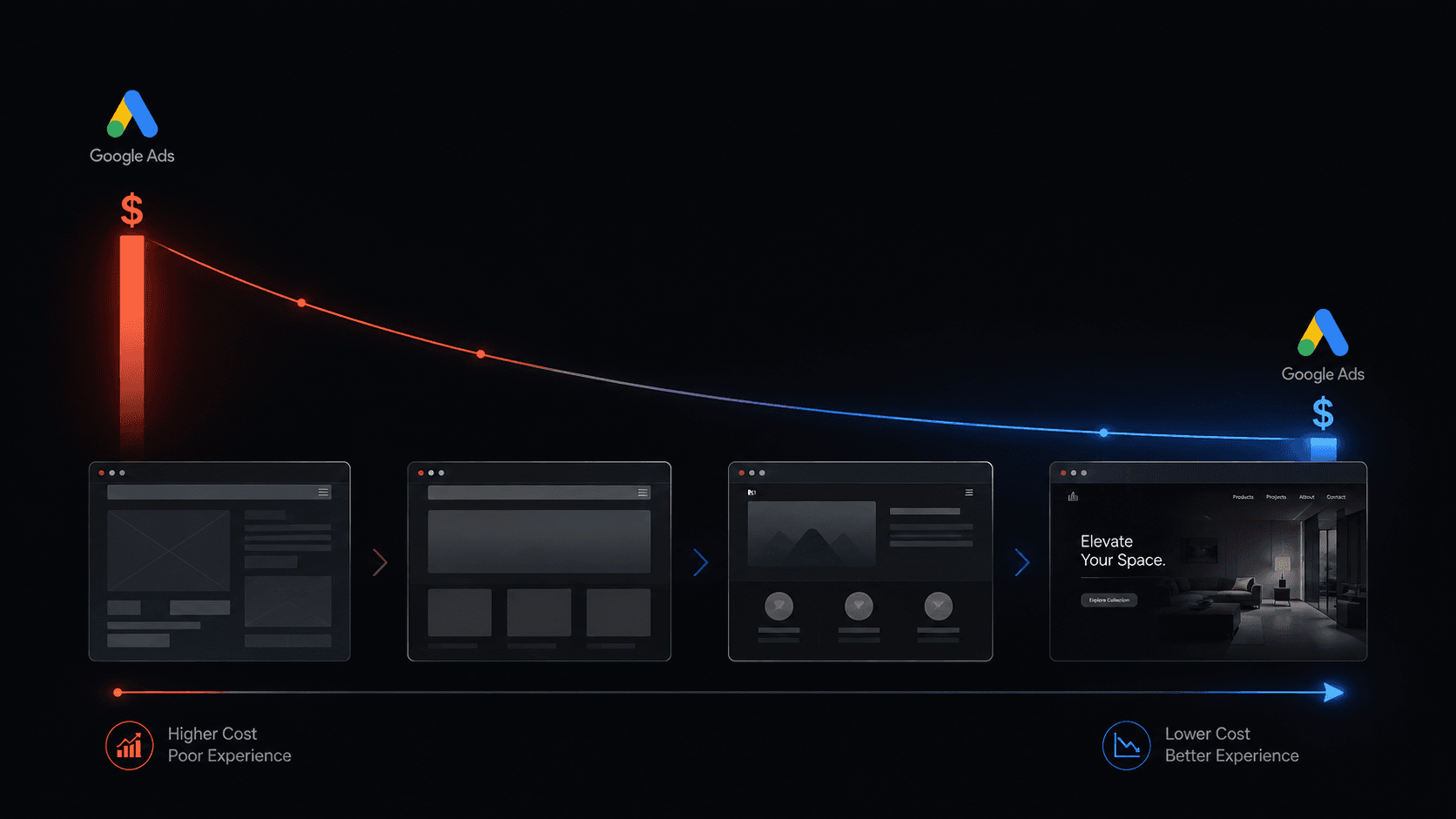
If it fails, hold off on concluding that paid search is too expensive in your category. Two of those four numbers are yours to change, and one of them moves the click price as well. Landing page quality is an input to what Google charges you per click, so a page that answers the query badly bills you twice, once in the leads you lose and once in the price you pay to get them. On a wedding photography account we took over, cost per click fell 74% after the site was rebuilt, with no change to keywords or bids.
When the searches exist and the arithmetic still fails, the honest answer is neither channel yet. Moving the budget to Meta buys colder traffic for the same page. Fix the page, then re-run the numbers.
Search loses this decision honestly in five situations, and I would rather list them here than find them on your account.
Nobody is searching for what you sell. New categories and unfamiliar formats do not appear in Keyword Planner, because nobody has settled on a word for them yet. There is no demand to capture, so the work is creating it, which is what Meta ads are for.
The purchase happens on sight. Jewellery, furniture, fashion, homeware, food. Nobody searches for a lamp they have not seen. They see the lamp. A feed is a good shop window for that and a text ad on a results page is a poor one.
The volume exists but it is trivial next to your market. A specialist B2B product might have 60 relevant searches a month worldwide while its real buyer pool runs to thousands of companies. Search will collect the 60 and will not build the business. Run it small and put the growth budget where the audience can be defined rather than waited for.
Your order value is low and your click price is not. If a customer is worth $40 and clicks in your category cost $6, search needs a conversion rate most sites will not reach. Meta's cheaper clicks give that arithmetic room, which is one of the few places the cost comparison earns its keep.
You already produce content. If you are shooting product video or customer stories every week, you own the expensive input that paid social runs on and that search has almost no use for. A business with a working social content operation can put budget behind it immediately, for a fraction of what starting from nothing costs.
What each channel asks of you every month
Both platforms will keep spending your money long after you stop paying attention. What they need from you to stay worth it differs, and neither cost appears on any comparison chart.
Meta needs new creative, continuously. The same audience sees the same ad, performance decays, and the fix is more production rather than a setting. If you have no way to make fresh video and images every few weeks, budget for someone who can before you budget for media, because the media spend goes nowhere without it.
Google needs a page that answers the query, and it needs the search terms report read every week. Loose matching will find you searches you never intended to buy, and the defence is adding negative keywords as they show up. That is the least glamorous hour in the discipline and skipping it is the most common way a search budget leaks.
The comparison worth running sits here: a creative pipeline on one side, a landing page and an hour a week on the other.
Running both, in the order that works
Every comparison closes by telling you to run both, which is true and unhelpful when you have one budget. The useful version is what the second channel adds once the first is producing.
If search went first, it hands you the exact language your buyers use. The search terms report is a list of real phrases real customers typed while wanting what you sell, and that beats any audience research you could commission as raw material for paid social copy. Start the second channel there.
If Meta went first, the earliest honest sign it is working shows up inside Google. People who see a good ad often do not click it. They search your brand name a day or two later. Branded searches climbing while paid social runs means the campaign is doing its job even where the platform's own attribution misses it. That is also the argument for having a small brand campaign live on search before you scale Meta, so that a competitor is not bidding on interest you paid to create.
What to do this week
Open Keyword Planner, build the list, set your location, and read the total. Then take the average click price and run the four numbers against your own conversion rates and your own customer value. Fifteen minutes, and you have an answer instead of an opinion.
Act on whichever gate fails. The one instinct worth resisting is picking the channel you can watch over the channel your customers are already using.
If you would rather run it with someone who works on both sides of the question, that is what our free account audit is for. We will build the keyword list, check the volume in your area, run the arithmetic against your real numbers, and say which channel to fund first. When the answer is Meta, we will say Meta.